Ads started appearing inside ChatGPT in Greece on 24 August 2026, as part of a 31-country European launch. Self-serve buying opened a week later. Since then the advice circulating in Greek marketing circles has been roughly: a billion users, thin competition, get in early.
Two of those three things are true. The third depends entirely on what you sell, and the data that settles it is public.
Who actually sees a ChatGPT ad?
Ads run on two plans only: Free and Go. Plus, Pro, Business, Enterprise and Education stay ad-free, and OpenAI has framed that as a permanent property of paying rather than a condition of the pilot.
So the first question is how those two groups compare in size. OpenAI answered it on 27 February 2026: 900 million weekly active users, 50 million consumer subscribers, more than 9 million paying business users.
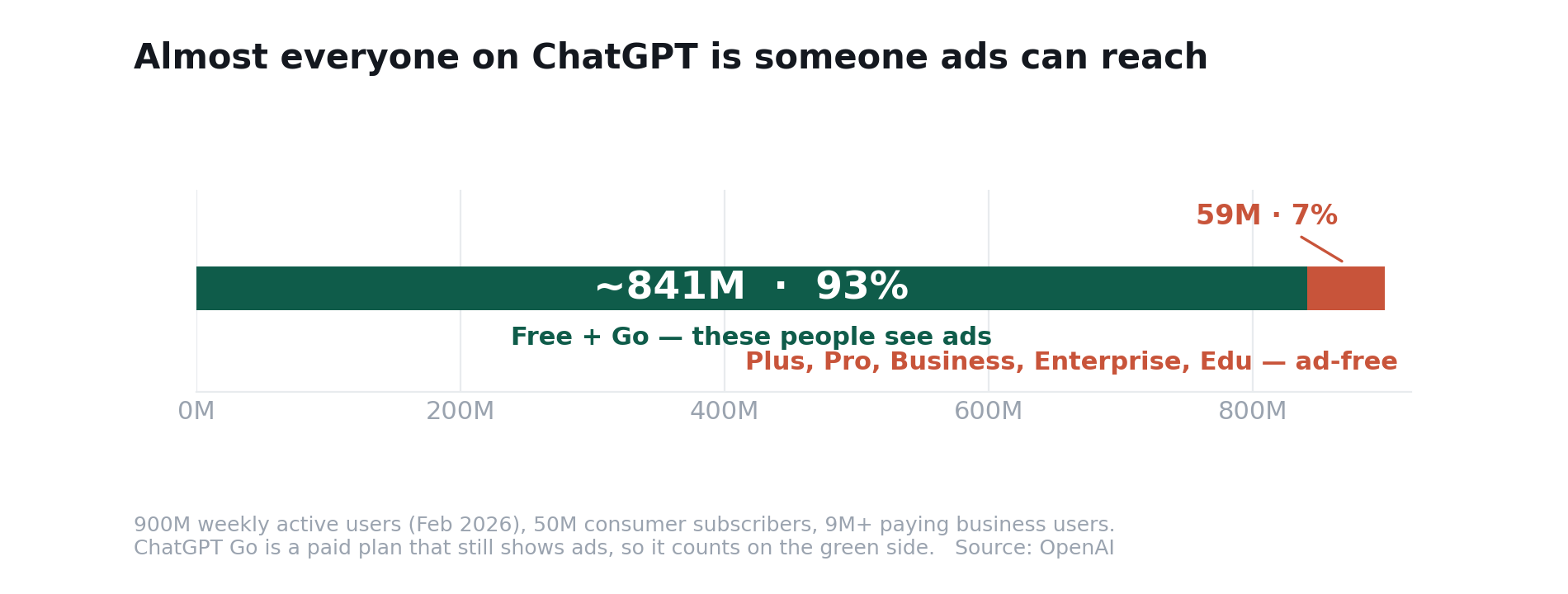
Roughly nineteen out of twenty weekly users sit on a plan that shows ads. If you had assumed the serious users have all upgraded by now, they haven't.
One detail in that split deserves attention. Go is the only plan where someone pays and still sees ads. At €8 a month it turns a free user into a subscriber without removing them from the inventory. That is deliberate product design, and it tells you how OpenAI intends to make the free tier pay for itself.
Why Greece is not an average European market
Greece is unusual, and unusual in a direction that matters here.
Eurostat's most recent survey found that 44% of Greeks aged 16 to 74 had used a generative AI tool in the previous three months. The EU average is 32.7%. Greece sits above Spain, France and Germany, within a few points of Denmark and Switzerland.
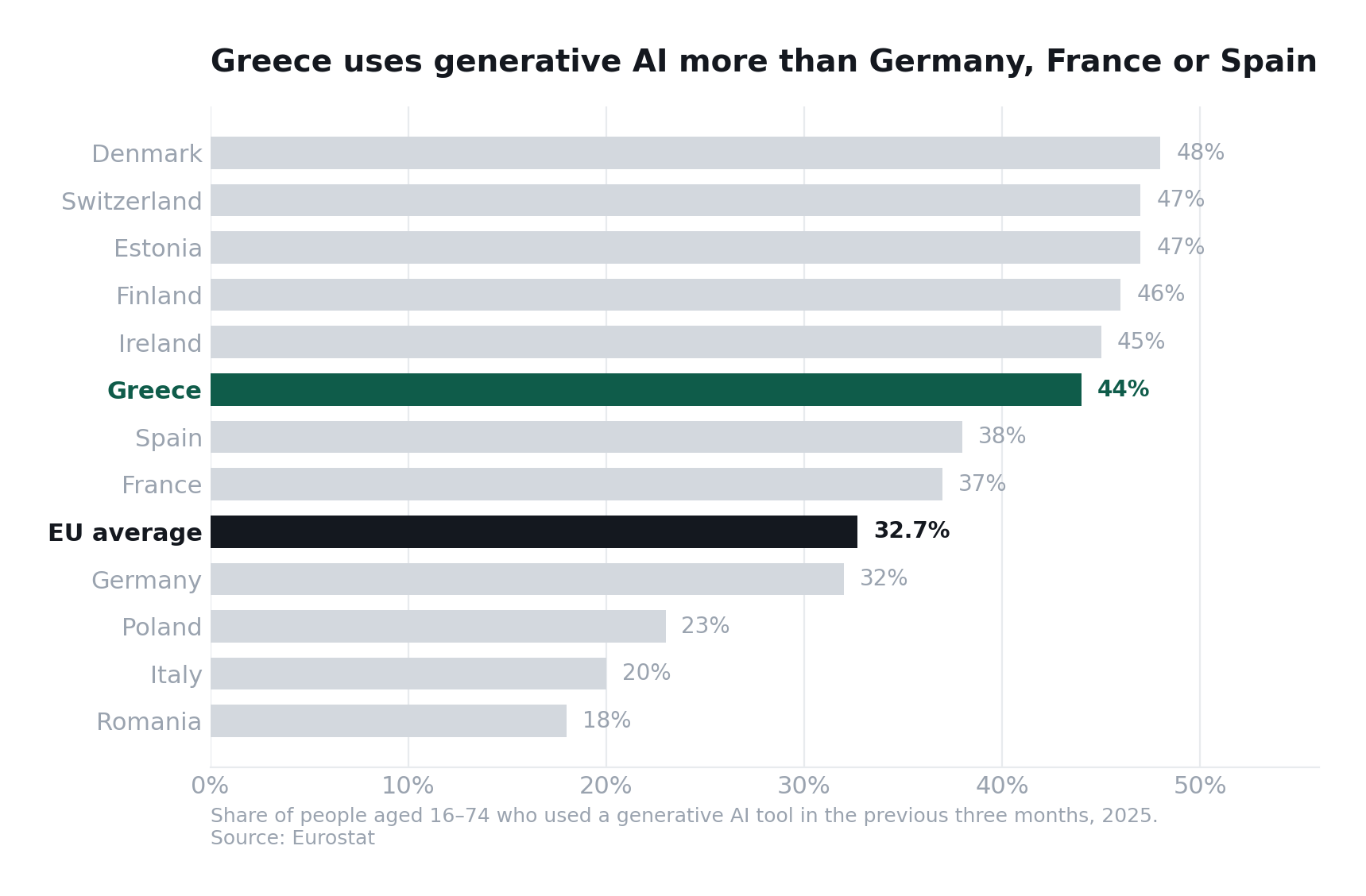
Among young people the number stops being merely high and becomes the highest in Europe.
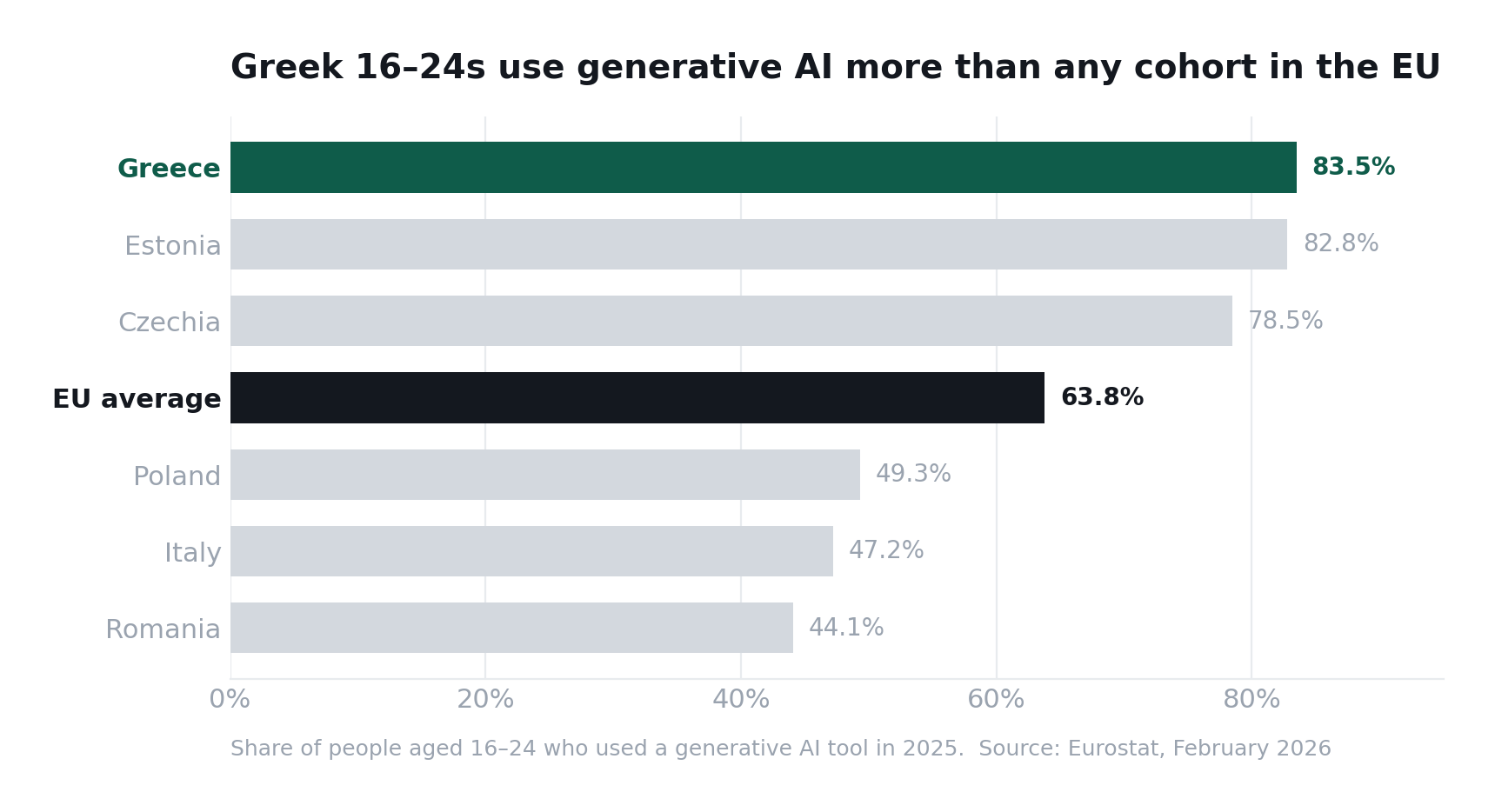
More than eight in ten Greeks aged 16 to 24 use generative AI. No other EU country reaches that. If you sell to a young Greek audience, they are already in the room — and the cheapest way to reach a student is the plan that shows ads.
Then comes the number that should shape the budget decision.
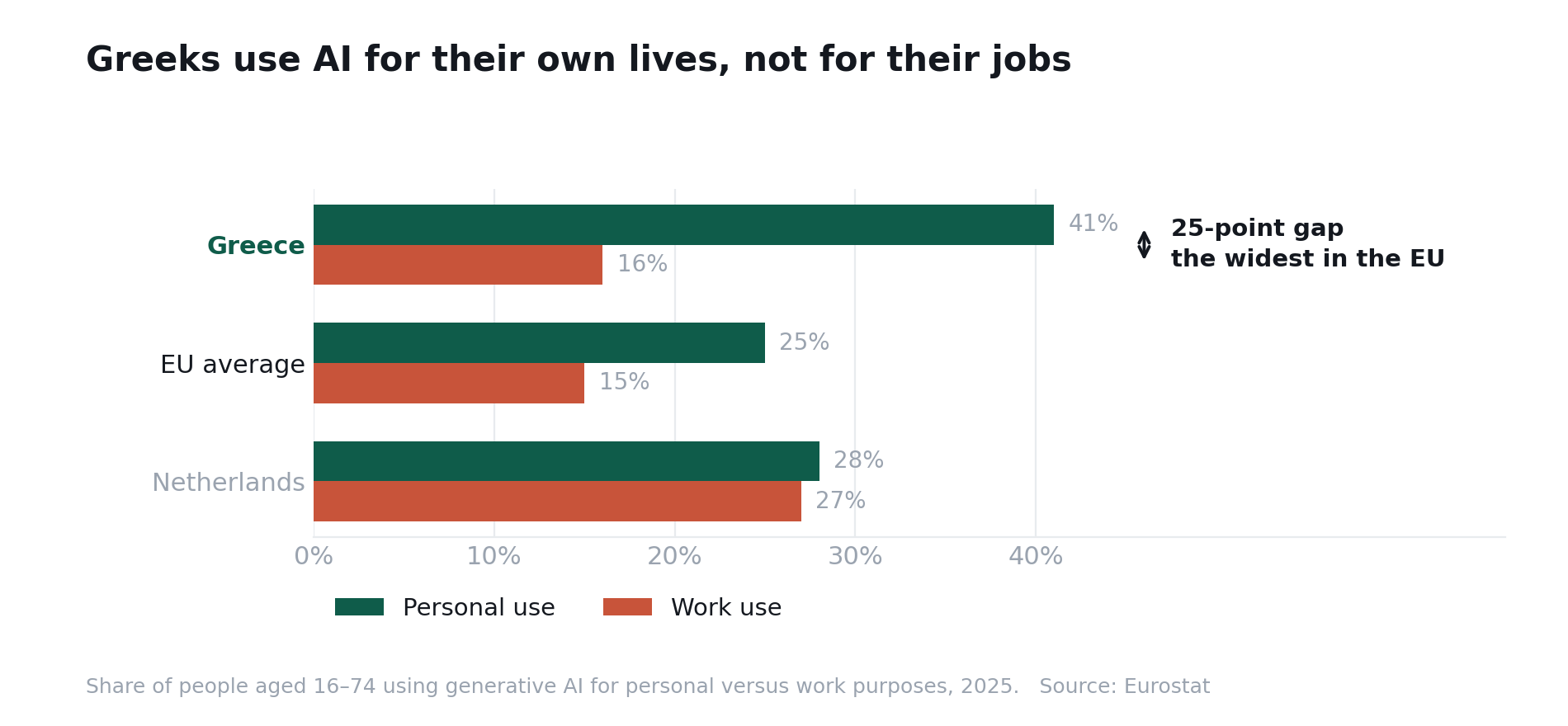
Greeks use AI for their own lives at 41%, and for work at 16%. The EU average gap is ten points. In the Netherlands it is one. In Greece it is twenty-five — among the widest on the continent.
The same Eurostat round shows the business side of that gap: Greek company adoption of AI sits near the bottom of the EU, alongside Bulgaria, Poland and Romania, against an EU average of around 20% of firms with ten or more employees.
Greece has consumer AI saturation and business AI scarcity at the same time. Nowhere in Europe is the split cleaner.
What people are actually doing in there
OpenAI now publishes usage data quarterly through its Signals programme. The March 2026 release makes the commercial shape of the inventory hard to miss.
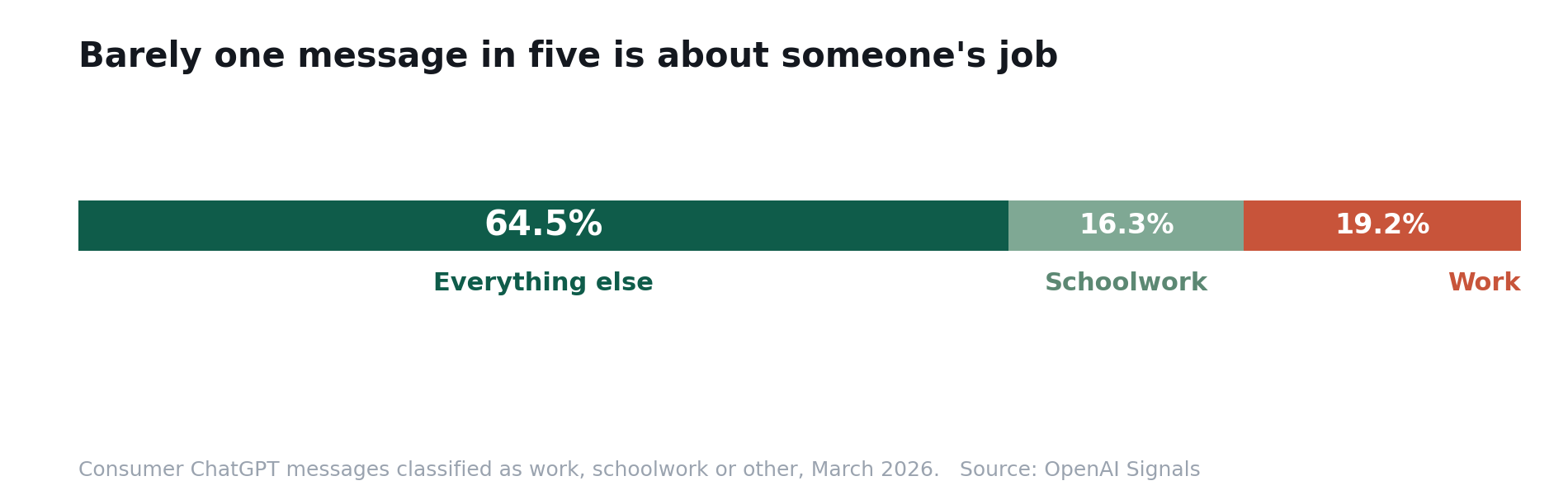
Under one message in five concerns someone's job. Schoolwork alone is almost as large as work — which, in the country with the EU's highest youth AI adoption, is not a footnote.
The direction of travel has not changed either.
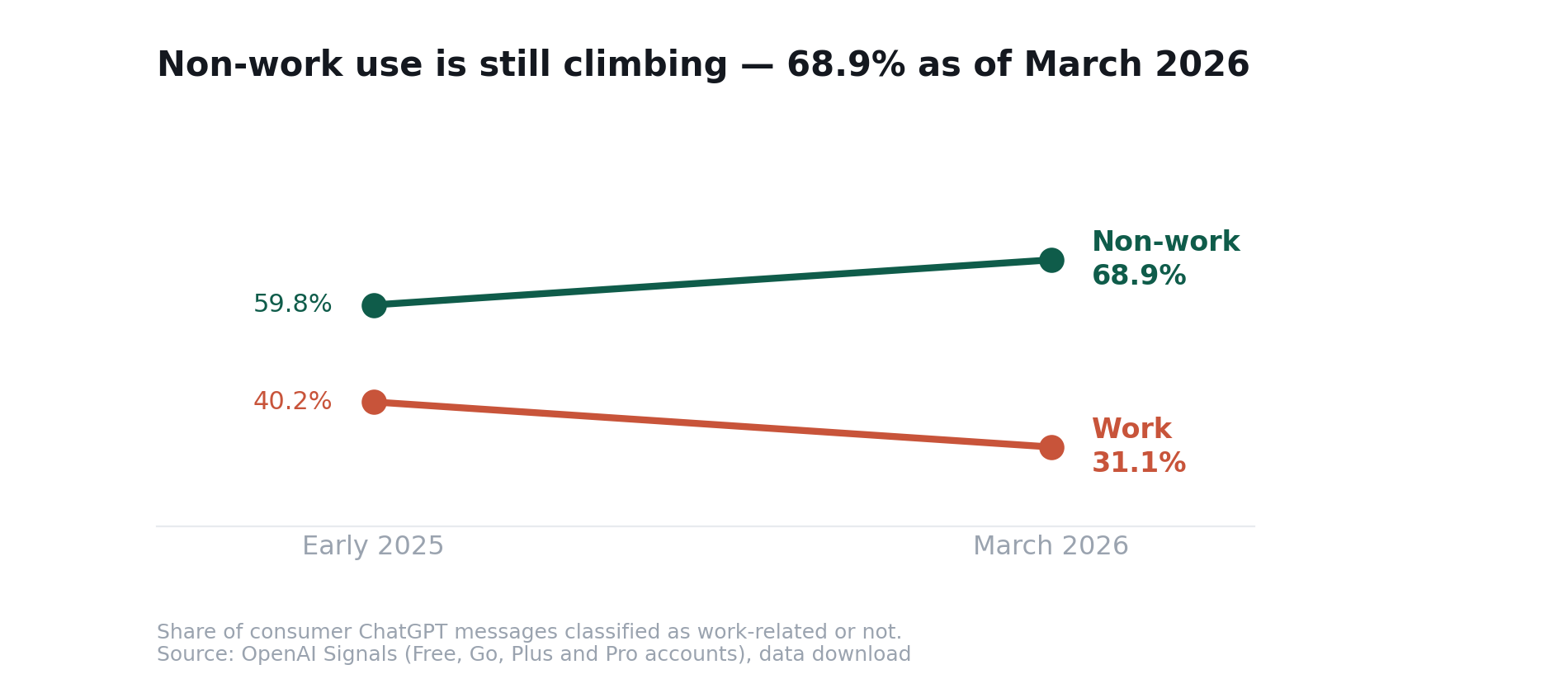
Non-work usage rose from 59.8% in early 2025 to 68.9% by March 2026. This is a product drifting further from the office every quarter, not closer to it.
The topic mix says the same thing from another angle.
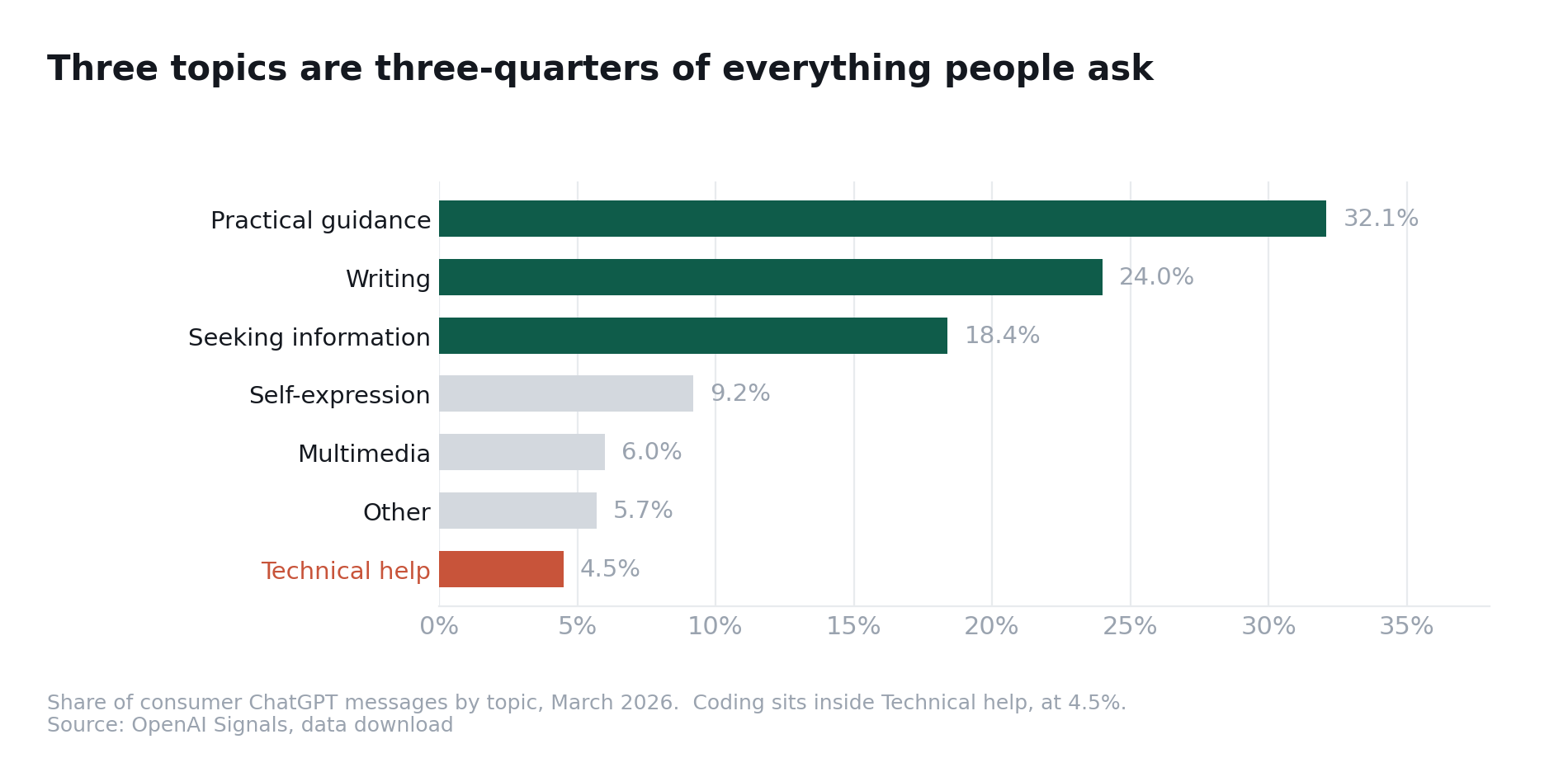
Practical guidance, writing and seeking information are three-quarters of everything asked. Technical help — the bucket that contains coding — is 4.5%.
The part that decides your budget
High volume in a consumer-shaped product is still a real opportunity. What decides whether it is your opportunity is who the remaining work usage belongs to.
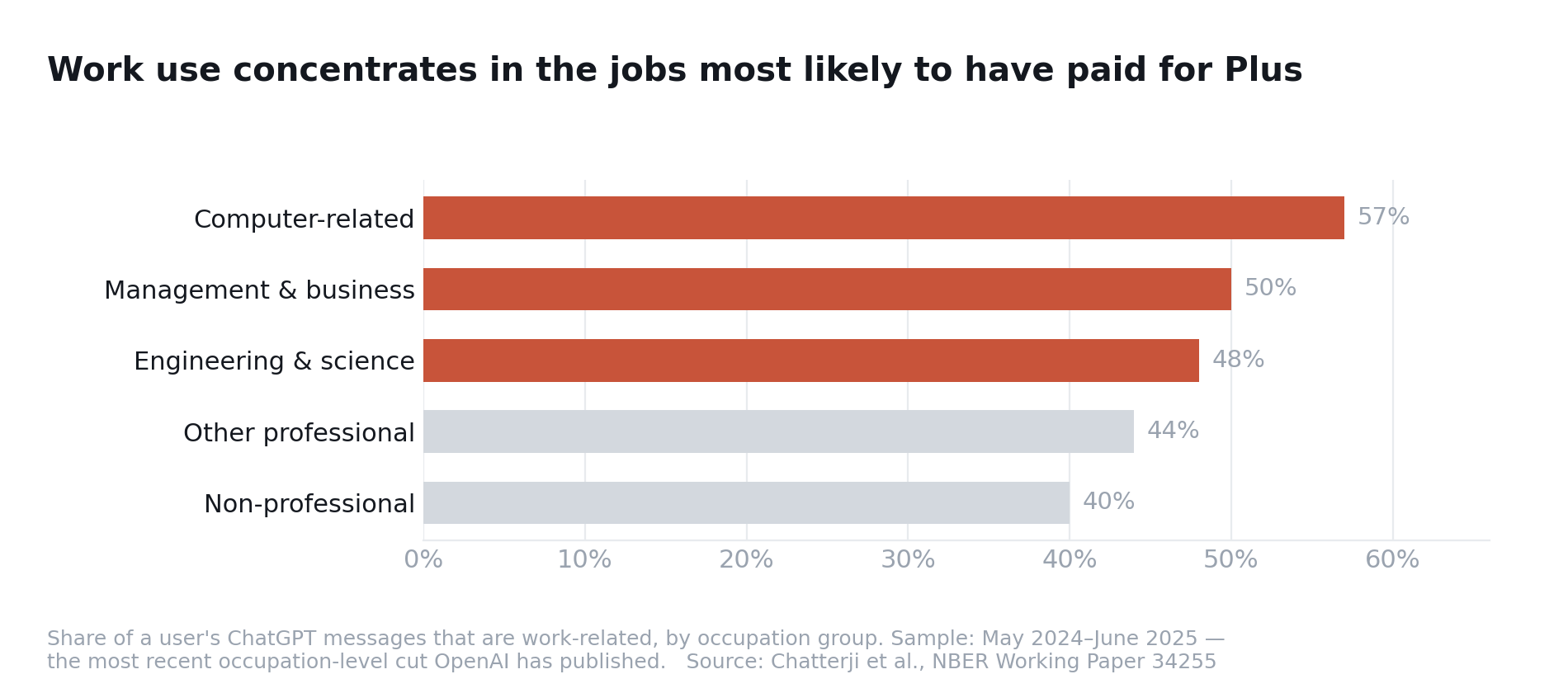
Work-related messages run at 57% for computer-related occupations and 50% for management and business, against 40% for non-professional roles. By education the pattern repeats: 37% for users without a degree, 48% for users with graduate education. The same research found that 47% of work messages from computer-related occupations are Asking — research, comparison, evaluation — against 32% from non-professional occupations.
That is the most recent occupation-level cut OpenAI has published, drawn from May 2024 to June 2025. Every newer release points the same way.
So the Greek professional who researches vendors inside ChatGPT is either on Plus, or on a seat their employer bought. No bid wins that impression, because the impression does not exist.
What you can actually buy in Greece today
Before anyone approves a budget line:
- One format. A sponsored card below the answer — title, short description, image, link. Labelled, and visually separated from the response.
- Thin targeting. Country, platform and first-party custom audiences. Reported to be no demographics, no lookalikes and no retargeting outside the US. For segmenting a Greek B2B audience this gives you close to nothing.
- Consent-split reach. Under GDPR, personalised ads in Greece require explicit opt-in. Users who decline still see ads, but only contextual ones — current conversation topic, approximate location, device type. Your reach is real; a large share of it carries no history behind it.
- Exclusions. Nothing to under-18s. Nothing near health, mental health or political topics. Nothing in Temporary Chat.
- Unpublished pricing. Trade reporting puts CPMs at roughly $60 during the closed US pilot, falling to around $25 once self-serve opened, with CPC bidding in the $3–5 range. OpenAI has published no rate card, so treat these as indicative.
Three conclusions, in order of confidence
Selling to Greek consumers: the maths works. Adoption is among the highest in Europe, youth reach is the highest, competition is close to nonexistent, and contextual matching against a live conversation sits closer to intent than a display impression. Start small, measure properly, and accept primitive targeting for the next few quarters.
Selling to Greek businesses: this is the wrong lever. Your buyers are structurally outside the inventory, and Greek business AI adoption is low enough that the pool would be thin even if they were in it. What reaches them is being the answer — the cited source, the named vendor, the firm ChatGPT returns when someone asks it to compare options. That is AEO work, and it is the only route into that audience.
Either way, stop treating "ChatGPT users in Greece" as one market. An €8 payment now separates two populations with measurably different behaviour. One you reach by buying media. The other you reach by earning the answer.
On sources
OpenAI is not a public company. It filed a confidential draft S-1 with the SEC on 8 June 2026, and its CFO has said a listing is expected in 2027. There are no audited quarterly filings behind any of the numbers above. That matters less than it sounds, because OpenAI publishes usage data voluntarily and in more detail than most listed companies do. OpenAI Signals releases its dataset under CC BY 4.0 with full methodology, currently covering messages through June 2026.
Two dating notes, so nothing here is read as fresher than it is. The 900 million weekly active user figure is OpenAI's last officially confirmed count, from 27 February 2026; reports since then put ChatGPT near or at a billion, but OpenAI has not confirmed that threshold for ChatGPT itself. The Eurostat figures come from the 2025 reference year, released in December 2025 and February 2026 — the most recent country-level European data available.
Primary sources: OpenAI Signals individual data and methodology (March 2026 release); OpenAI's February 2026 user and subscriber announcement; OpenAI's ChatGPT Go, advertising and European rollout announcements; Eurostat, Use of generative AI tools by individuals (2025 reference year); Chatterji, Cunningham, Deming, Hitzig, Ong, Shan and Wadman, How People Use ChatGPT, NBER Working Paper 34255.
Reported, not company-confirmed: CPM and CPC figures, and the detail of targeting options outside the US.
Frequently Asked Questions
Do ChatGPT ads work for Greek businesses?
For selling to Greek consumers, yes — adoption is among the highest in Europe and competition is minimal. For selling to Greek businesses, no: professional buyers who research vendors inside ChatGPT are mostly on ad-free paid plans, so the impression you'd bid on doesn't exist. Reaching them requires AEO — being the cited answer — not ad spend.
Which ChatGPT plans show ads?
Ads run only on Free and Go. Plus, Pro, Business, Enterprise and Education stay ad-free. Go is notable because it's a paid plan (about €8/month) that still shows ads. Roughly 93% of weekly active users are on an ad-eligible plan.
How much do ChatGPT ads cost?
OpenAI has published no official rate card. Trade reporting put CPMs around $60 during the closed US pilot, falling to roughly $25 after self-serve opened, with CPC bidding in the $3–5 range. Treat these as indicative, not confirmed.
What targeting is available for ChatGPT ads in Greece?
Country, platform and first-party custom audiences only — reportedly no demographics, no lookalikes and no retargeting outside the US. Under GDPR, personalised ads in Greece require explicit opt-in; users who decline still see contextual ads based on the current conversation, approximate location and device type.

Taxiarchis Vafeas
AI Advertising & AEO · Digital Marketing Consultant
Helping Greek businesses decide where the budget actually works — and get named inside the answers AI engines give.